
He called your turn bet with a weak pair three times tonight. You noticed; a solver can’t.
A solver’s strategy is built against an opponent who plays as well as the solver does. Node locking is how you tell it about the player you actually face. You enter how often he folds, calls or raises with each possible hand at one decision, then hold that strategy fixed. The solver works out how you should adjust and how he could fight back at every decision you leave unlocked.
In a spot we solved twice, a correct turn lock raised the least we could earn on average by $7.52 a hand in a $100 pot, even against his strongest replies elsewhere. But when we also locked a mistaken river read, an opponent who found the right counter could make our strategy lose money. The turn read was still right; the extra river read created the opening.
The Three Ideas Behind Node Locking
- A solver gives you a baseline that is hard to exploit. In a heads-up game without rake, an exact equilibrium guarantees the spot’s theoretical value against any allowed reply. That guarantee holds for the ranges, stacks and bet sizes you modeled; a weak range can still lose money. Practical solves approximate that protection. Our poker solver guide explains how.
- Real players don’t play that strategy in every spot. They call too much on one street, fold too much on another, and almost never raise on a third. Most of these habits repeat, which is what makes them readable.
- You can lock a decision to your read of the player. Enter how he plays each hand at that decision and solve again. The solver treats your read as fixed and finds a strategy that exploits it while accounting for his best replies everywhere else. That protection is conditional: he must keep playing the locked decision the way you entered it.
How a lock works
One decision fixed. Everything else re-solved.
| Decision | Actions | Ordinary solve | Locked solve |
|---|---|---|---|
| You · turn | Bet or check | Solved | Re-solved |
| Villain · turn | Fold, call or raise | Solved | Locked |
| You · river | Bet or check | Solved | Re-solved |
| Villain · river | Fold, call or raise | Solved | Re-solved |
The locked decision never moves. Every other decision, yours and his, is solved again around it.
The third idea has an advantage and a cost. We’ll put numbers on both.
What a Node Is, and What a Lock Says
A node is one decision point in a hand: one player to act, after one exact sequence of bets, on one board. Once the board and earlier action are specified, “Villain, on the turn, facing a 75% pot bet” identifies a node.
At each decision node, the solver maintains a strategy for the player’s range, stored as a data table. Each row is one possible two-card combination, or combo, such as A♠ K♥. Each column is an action. The entries say how often that combo takes that action.
For a full-range lock, you fill in that strategy table. It has three parts:
- The spot: which decision you are fixing.
- The hands: every hand he can hold there, including the ones you have never seen him show down.
- The frequencies: how often each hand takes each action.
Some solvers also let you lock only selected combos and keep solving the others. In this article, we lock the whole range at one decision.
Here is the lock we use in the example below. You raised on the button, Villain called from the big blind, and he called your bet on a K♠ 9♠ 4♦ flop. The turn is the 2♣. He checks, and you bet 75% of the pot. He can fold, call or raise.
Example lock
A lock is a table you fill in.
Turn board
$100 potYour bet: $75He can fold, call or raise to $225
- Fold
- Call
- Raise to $225
All hands
201 combos · 100% of his range
- Solver's version of him
- Fold 47%, Call 51%, Raise to $225 2%
- Your lock
- Fold 18%, Call 74%, Raise to $225 8%
Two pair or better (sets, K9, K4, K2)
16 combos · 8.0%
- Solver's version of him
- Fold 0%, Call 79%, Raise to $225 21%
- Your lock
- Fold 0%, Call 0%, Raise to $225 100%
Top pair (any other king)
45 combos · 22.4%
- Solver's version of him
- Fold 0%, Call 100%, Raise to $225 0%
- Your lock
- Fold 0%, Call 100%, Raise to $225 0%
Second pair (any nine)
27 combos · 13.4%
- Solver's version of him
- Fold 0%, Call 99%, Raise to $225 1%
- Your lock
- Fold 0%, Call 100%, Raise to $225 0%
Third pair (A4, 54)
6 combos · 3.0%
- Solver's version of him
- Fold 0%, Call 92%, Raise to $225 8%
- Your lock
- Fold 0%, Call 100%, Raise to $225 0%
Small pocket pairs (88 to 55)
24 combos · 11.9%
- Solver's version of him
- Fold 93%, Call 7%, Raise to $225 0%
- Your lock
- Fold 0%, Call 100%, Raise to $225 0%
Flush draws (two spades)
14 combos · 7.0%
- Solver's version of him
- Fold 28%, Call 70%, Raise to $225 2%
- Your lock
- Fold 0%, Call 100%, Raise to $225 0%
Gutshots (QJ, QT, JT)
33 combos · 16.4%
- Solver's version of him
- Fold 97%, Call 3%, Raise to $225 0%
- Your lock
- Fold 0%, Call 100%, Raise to $225 0%
Ace-high (AQ, AJ, AT)
36 combos · 17.9%
- Solver's version of him
- Fold 99%, Call 1%, Raise to $225 0%
- Your lock
- Fold 100%, Call 0%, Raise to $225 0%
The solver’s version of this player folds 47% of his hands, calls 51% and raises 2%. Yours folds 18%, calls 74% and raises 8%: he never folds a pair or a draw, and he raises only with two pair or better.
Each row is a group of similar hands, and the frequencies are averages for the group. The real table has one row for each of his 201 possible hands, and one column for each action.
A Worked Example: One Lock on the Turn
Same hand as above. The board is K♠ 9♠ 4♦ 2♣, there is $100 in the pot, and you both have $500 behind. Villain checks. You can check or bet $75. To keep the example small, Villain always checks first. Facing a bet he can fold, call or raise, and facing a raise you can fold, call or move all in. The river is played the same way.*
We solved the spot twice with our solver: once with nothing locked, and once with Villain’s turn response locked to the table above.
Worked example · One lock on the turn
Thinner value bets. Far fewer bluffs.
Turn board
$100 pot$500 behind eachVillain checks to you
- Check
- Bet $75
All hands
171 combos · 100% of your range
- Nothing locked
- Check 45%, Bet $75 55%
- His turn response locked
- Check 43%, Bet $75 57%
Top pair or better (any king, sets, AA)
48 combos · 28.1%
- Nothing locked
- Check 0%, Bet $75 100%
- His turn response locked
- Check 0%, Bet $75 100%
Pairs below top pair (QQ to TT, A9, T9, 98)
27 combos · 15.8%
- Nothing locked
- Check 100%, Bet $75 0%
- His turn response locked
- Check 0%, Bet $75 100%
Draws (flush draws, gutshots)
54 combos · 31.6%
- Nothing locked
- Check 28%, Bet $75 72%
- His turn response locked
- Check 59%, Bet $75 41%
No pair, no draw (ace-high, missed connectors)
42 combos · 24.6%
- Nothing locked
- Check 81%, Bet $75 19%
- His turn response locked
- Check 95%, Bet $75 5%
Three hands, before and after the lock
| Your hand | Baseline | Locked | Why |
|---|---|---|---|
| T♥ 9♥: Second pair (thin value) | Check | Bet | Every smaller pair and every draw now calls it. |
| 8♥ 7♥: Eight-high (pure bluff) | Bet 81% | Check | He folds too rarely. Counting the river, checking now earns $7.57 and betting $6.88. |
| A♥ K♦: Top pair, top kicker (value) | Bet | Bet | Same play. In the locked solution this hand is worth about $33 more. |
Both solutions come from the same ranges, stacks and bet sizes. The only input that changed is Villain’s turn response.
* Example ranges for a button raise and a big blind call, after a bet and a call on the flop. You hold 171 possible hands and Villain holds 201. You bet 75% of the pot and he raises to three times the bet. Either becomes all in when the stacks are short, and a re-raise is always all in. Villain never leads, and there is no rake. A different range, bet size or board gives different numbers.
The solver arrived at advice you already know: against a caller, value bet thinner and bluff less. What it adds is with which hands. Pairs below top pair go from never betting to always betting. Hands with no pair and no draw go from betting 19% of the time to 5%. Draws drop from 72% to 41%, because with fewer folds a semi-bluff is worth less. And when he raises, you fold 84% of the time instead of 50%, because in your lock a raise always means two pair or better.
What the Lock Was Worth
Expected value, or EV, is what a play earns on average. The numbers below are your average across every hand you can hold here, starting from this turn decision. The $100 already in the pot counts as money to be won. A floor is the worst-case EV: what remains when he chooses the strongest counter outside the turn lock.
What the lock was worth
One lock raises your floor.
Total EV per hand, from this turn onward
- Baseline strategy · no leak
- $59.80
- Reference: the original solution. His strongest counter also leaves about $59.80.
- Baseline strategy · turn leak
- $60.63
- Floor with the turn leak: $0.83 above the reference.
- One-lock strategy · turn leak
- $68.15
- Floor with the turn leak: $7.52 above the unchanged strategy.
The estimated floor rises from $60.63 to $68.15. His turn response stays fixed; everywhere else, he chooses the strongest counter to each strategy.
The last two rows compare worst-case returns, not two strategies against one unchanged opponent. His best play outside the turn lock can differ between rows. Values average over your whole range; individual hands vary. Differences are calculated before rounding EVs to cents.
You can collect part of a leak without changing your strategy. The baseline’s worst-case return rises by $0.83 when his turn response is fixed to the leak. Adjusting to that lock raises the floor by another $7.52, even after letting him find his best counter everywhere else.
The Cost of a Misread
“The player with the turn leak” has a precise meaning here. He responds to the turn bet exactly as you locked it, and then plays every other decision as well as anyone could against the strategy he is facing. That is what a solver assumes about every node you leave unlocked.
This is why leaving the rest unlocked matters: you can exploit his turn calls without needing a correct read of his river play. As long as his turn response matches your lock, even his best counter everywhere else leaves you about $68.15 in this model.
The turn read still has to be right. If he is free to abandon the turn leak and find the strongest counter across the whole hand, the single-lock strategy can lose $1.17 from this decision onward. That is about $61 below the unadjusted baseline’s $59.80 against its strongest counter. Even one lock can be costly when the read is wrong.
Compare that with going all the way. Suppose you also believe he plays the river just as straightforwardly: he raises with two pair or better (trips or better once the board pairs), calls with any other hand at least as strong as top pair, and folds the rest. He never folds a hand he would raise, including to your turn shove. Lock all of that, on every river card, and none of his decisions are left for the solver to work out. The problem becomes finding a best response to a fixed opponent: the highest-EV play with each hand. Nothing is held back for protection, because this opponent can no longer adjust.
One lock vs a complete read
The full lock has more upside and more room to be punished.
Each group is a strategy, named for the reads used to build it. The two bars show what the opponent actually does.
- The turn read holds: worst-case EV
- The complete read holds: fixed-opponent EV
No locks
- The turn read holds: worst-case EV
- $60.63
- The complete read holds: fixed-opponent EV
- $61.64
One turn lock
- The turn read holds: worst-case EV
- $68.15
- The complete read holds: fixed-opponent EV
- $69.55
A complete opponent read
- The turn read holds: worst-case EV
- −$8.94
- The complete read holds: fixed-opponent EV
- $79.86
The turn-read bars give each strategy its own strongest counter outside the turn lock. The complete-read bars evaluate all three against the same fixed opponent. All values are total EV from the turn onward, including the $100 pot already there. The complete-read strategy is one best response; equally good plays against that fixed read can fare differently against a counter.
Each adjusted strategy is best in the case it was built for. The full lock earns $79.86 when every read is right. If the river read is wrong and he finds the strongest counter, the strategy we computed can lose about $9 a hand. The single lock’s worst-case return stays at about $68.15 while the turn read remains right.
The reason is on the river. After a checked turn, the full lock bets the river four times out of five, because the read says he folds everything below top pair. Then it folds to a raise almost every time, because the read says a raise always means two pair or better.
You can see it with the eight-high hand from earlier. With 8♥ 7♥, the complete-read strategy checks the turn. On a 3♦ river, it bets $75 into $100, expecting hands below top pair to fold. The modeled opponent folds A♠ Q♥. The strongest counter raises that same hand to $225, and we fold, losing our $75 bluff.
A player who calls and raises instead takes those bets. The single lock gives up some of the upside, and in return it depends on only one read.
The Catch: One Lock Is One Decision
Against the player who also plays the river straightforwardly, the single lock left $10.31 a hand uncollected. Collecting it means locking his river play, and his reply to a turn shove, as well. His river play depends on which card falls, so that is not one more table. It is four tables for every river card, one for each way the betting can reach him.
Game tree size
A whole opponent is a lot of tables.
- This example
- 629
- decision points across both players, as the solver stores them. Villain makes a real choice at 194. Two streets, one bet size, one raise size.
- A full flop tree for the same matchup
- 2,893,960
- decision points across both players, stored the same way, each with a row for up to 1,176 hands. Button against big blind on a K-9-4 flop.
The full tree is one flop from our own solve of this matchup, with wider ranges, more bet sizes and raises on every street.
Even this small example needs 37,386 hand-by-hand entries to describe Villain completely. Across a full flop tree, each decision can have up to 1,176 possible hands, every two-card combination that does not use a flop card. Filling in all those frequencies by hand is impractical, and every extra assumption can be wrong.
Use node locking for decisions you have evidence for, with the solver accounting for the opponent’s best play everywhere else.
You don’t have to enter a strategy by hand at millions of decisions to study a whole opponent. In Poker Shark, each training opponent already has a complete modeled strategy on every street. Hand Lab shows the best response to that style alongside the GTO baseline. You can study the adjustment without writing every lock yourself. The best response is tailored to that model; its success against a real player still depends on how well the model fits.
Inside Poker Shark · Best Response feedback
The best response is ready to study.
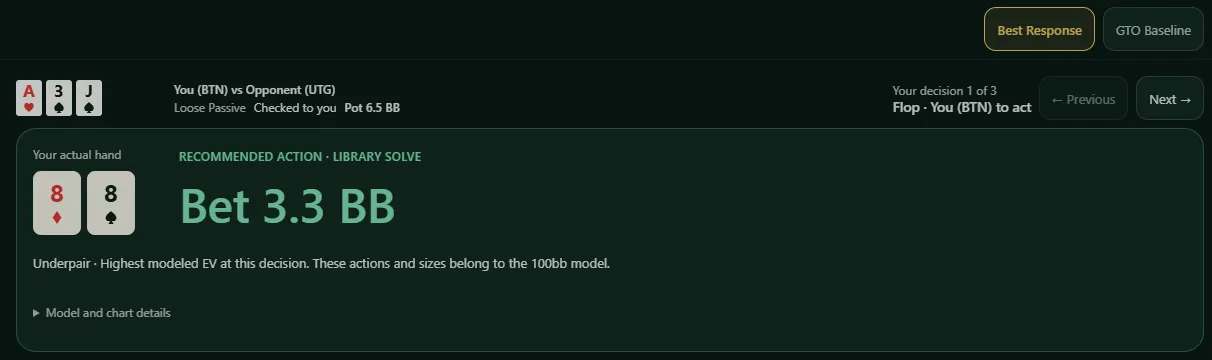
The Best Response tab shows the adjusted play for a complete opponent style; the GTO Baseline tab is available beside it. Here Hand Lab recommends betting 3.3 big blinds with pocket eights against the Loose Passive player on an ace-high flop.
Explore Hand Lab feedbackSelect an image to view it full size.
How to Use Node Locking in Your Own Study
- Start from the unlocked solution. You need the baseline to see what the lock changed.
- Lock a habit you have seen more than once. Look for the same street, a similar bet size and a similar board. One showdown is a reason to watch, not a reason to lock.
- Fill in hands, not a label. “Loose” is not a lock. “Never folds a pair or a draw to a turn bet” is. Decide what every hand in his range does, including the hands he folds.
- Change one node at a time. Solve again, then read the difference: which of your hands switched, and how far the EV moved.
- Ask what you left unlocked. The solver is assuming he plays those spots well. If you have a read there too, that is a second lock and a second chance to be wrong.
- Test more than one version of the lock. Try him calling 70% of those hands as well as 100%. If the advice only appears at 100%, you need a very strong read to act on it.
Use Shark Vision to practice identifying which hands take an action against a modeled opponent. For a real player, your lock still needs observations from comparable spots.
Inside Poker Shark · Shark Vision
See which hands take the action.
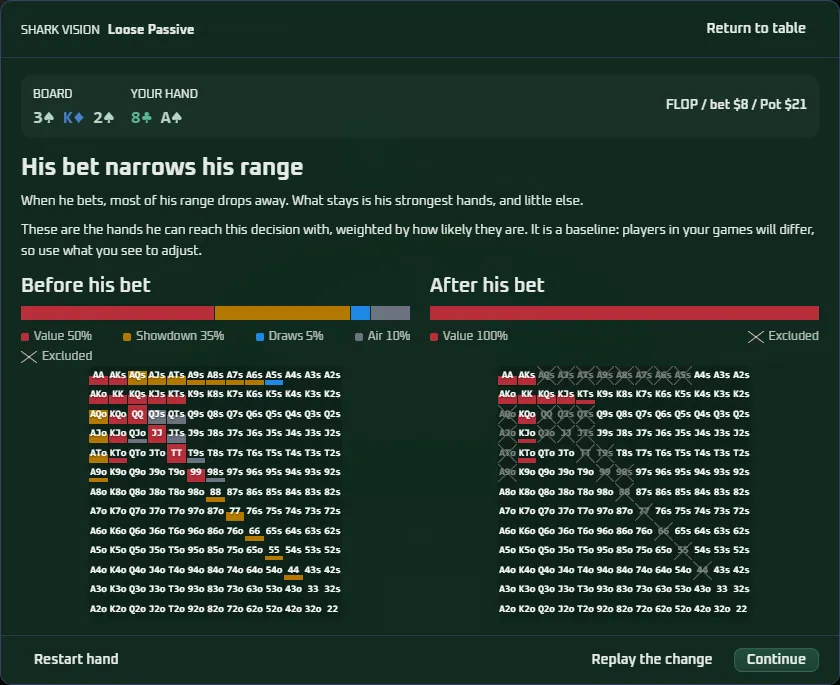
Shark Vision shows the Loose Passive player’s range before and after an $8 bet on 3♠ K♦ 2♠: the weaker hands drop out and only value remains. Before the bet his range is 50% value, 35% showdown hands, 5% draws and 10% air; after it, value is all that is left. Views like this help you see which hands take an action. A lock also needs how often each of them takes it.
Explore range study with Shark VisionSelect an image to view it full size.
To practice the reads themselves, start with the free three-hand diagnostic. It needs no account and explains each decision.
How a Solver Holds a Lock
At locked decisions, the solver always uses the frequencies you supplied. At every other decision, both players keep adjusting. That is how it tests your exploit against the opponent’s strongest allowed replies.
Optional: see the learning loop and code
Counterfactual regret minimization, or CFR, compares what each action would have earned, records the difference as regret, and shifts toward actions with positive regret. Its answer is a weighted average of the strategies played during the solve.
Formally, an information set describes what one player knows, including their own hand. The sample below groups all hands at a decision into a NodeStrategy. A LockedStrategy returns your supplied frequencies and ignores regret updates.
Optional · The learning loop in code
Same three requests. One version stops learning.
NodeStrategy
class NodeStrategy:
  regrets       # per hand/action
  strategy_sum  # running total

  def current_strategy():
    return regret_matching(regrets)

  def update_regrets(new, reach):
    played = current_strategy()
    strategy_sum += reach * played
    regrets += new

  def average_strategy():
    return normalize(strategy_sum)
It records what it just played, then shifts toward whatever would have earned more. Regret matching plays each action in proportion to its positive regret, or an even mix when no action has any.
LockedStrategy
class LockedStrategy:
  locked        # your frequencies

  def current_strategy():
    return locked

  def update_regrets(new, reach):
    pass        # nothing to learn

  def average_strategy():
    return locked
Its strategy is your read, from the first pass to the last.
Simplified to show the idea. Everything is kept separately for each hand. new is the regret each action picked up on this pass, and reach is how often the hand arrives at this node under its own player’s strategy. Some CFR variants also discount early passes.
The same learning loop can use either object. Unlocked decisions keep adapting, so the solve accounts for the opponent’s best replies outside your lock. The open-source TexasHoldemSolverJava shows a similar interface in its Trainable class, although it does not implement node locking.
Sources and limitations
- PioSOLVER’s node-locking guide shows how locking works in a commercial solver.
- GTO Wizard’s The Limits of Nodelocking covers what a few locks can and cannot tell you about an opponent.
- Zinkevich, Johanson, Bowling and Piccione’s Regret Minimization in Games with Incomplete Information is the paper that introduced CFR. It also defines information sets.
- The open-source TexasHoldemSolverJava project shows a
Trainableinterface similar to the sample’s. It does not include node locking. - Johanson and Bowling’s research on exploiting an opponent with an incomplete read studies the trade-off between exploiting a read and staying hard to exploit.
These results describe one modeled spot with a limited bet menu and no rake, not a prediction of your win rate. EVs are rounded to cents, and a different range, board, bet size or opponent can change the result.
How we checked the numbers
The worked example was solved with Poker Shark’s CFR solver. The strategy sources were the generation-matched br.bin files for the two solves (s0.bin and s1.bin), stored at float32 precision. The calculations used tables read from those files through the solver’s explorer, rounded to 0.1 percentage points. We evaluated those rounded strategies by enumerating compatible opponent hands and river cards, including the opponent’s best replies outside the lock.
A separate check compared 342 hand and action values per solve with the explorer’s EV output; the largest difference was two cents. This checks our evaluation of the exported strategies, rather than proving exact equilibrium or exact values for the unrounded strategies. EVs are shown to the nearest cent, and small differences from strategy rounding are possible.
The complete-read strategy is one best response, selecting the first maximizing action when plays tie. A separate check kept its $79.86 return against the fixed read but changed which tied action was selected: the two tested versions had floors of −$8.94 and −$14.87 with the turn leak still fixed. Those are examples, not bounds on all best responses. The river hand above uses the first version.
The full-tree count comes from our stored solution for that flop.
Our research methodology explains how we build and evaluate the training opponents.