 Poker Shark
Replay any poker hand. Test what you should have done.
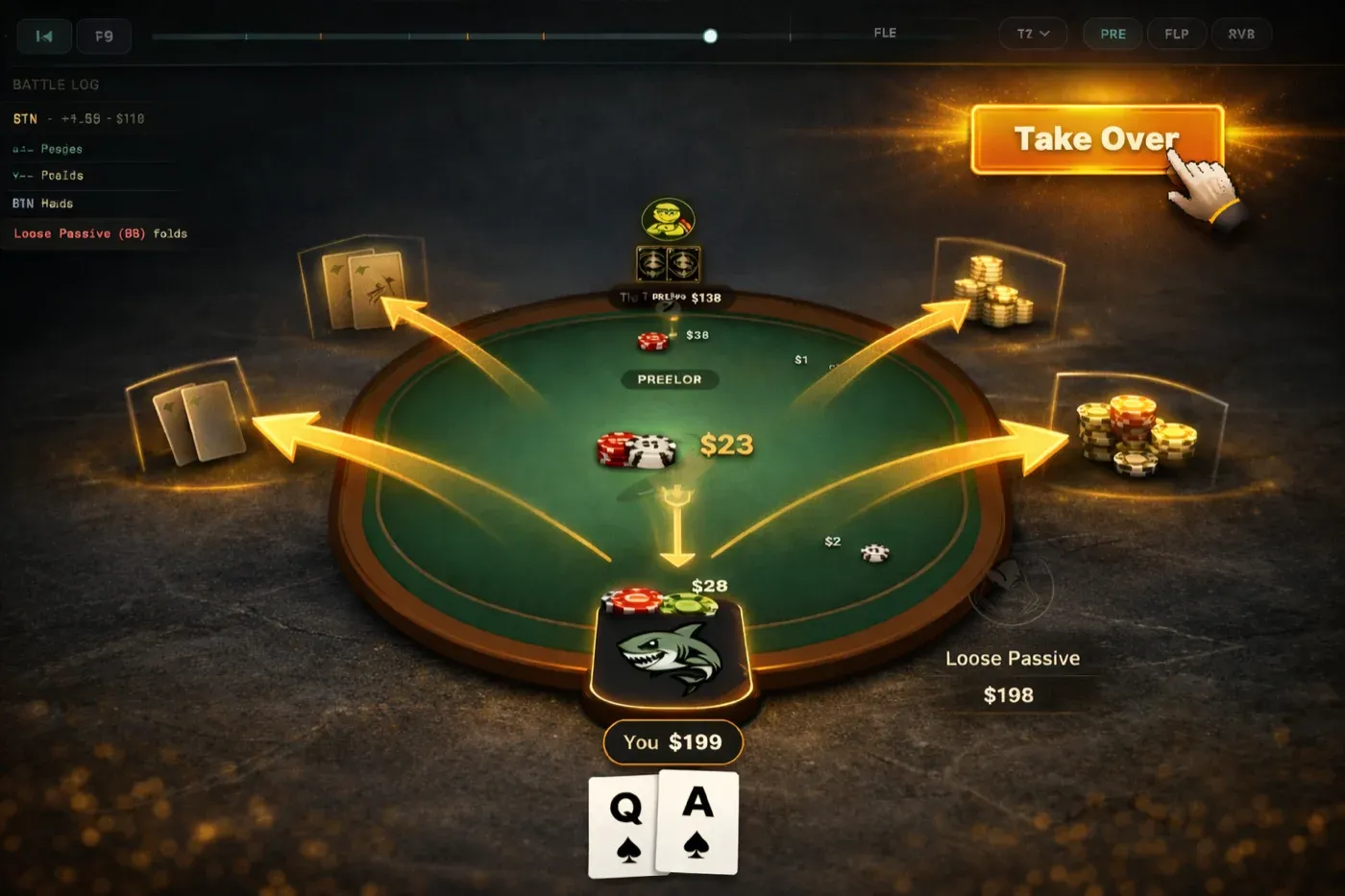
Every hand is saved automatically. Replay it step by step, jump to any decision point, and test an alternate line to see what would have happened against the same opponent.
Start reviewing freeEvery hand saved automatically. No setup required.
Why poker hand review matters more than volume
Playing hands without reviewing them reinforces bad habits. Every hand you review comes from the training arena, and the same thesis — that review beats volume — is the core argument in how to practice poker without risking real money. Here are the three problems that good hand review solves.
The memory problem
At a live table, you play a hand and it's gone. You remember the result but not the reasoning. Without a record, you can't distinguish good process from good luck.
The one-path problem
Every hand follows a single path. But what if you had checked? Raised instead of called? The hand you could have played is where the learning lives.
The results problem
You lost a big pot, so it must have been a bad play. Not necessarily. Results-oriented thinking is one of the biggest obstacles to improvement. Proper review separates decision quality from outcome.
How to review and replay poker hands, step by step
Open the hand
Every hand from the training arena is saved automatically. Open any hand from your library — you'll see your cards, the board, the pot, and every action in sequence.
Scrub to the decision
Use the timeline to jump to the exact moment you want to analyze. The river bet you weren't sure about. The flop check-raise you considered but didn't pull.
Take over and branch
Click takeover at that decision point. Make a different choice — bet instead of check, raise instead of call. The opponent responds based on their tendencies and the hand plays out to completion.
Compare the lines
Your branch is saved alongside the original. See the profit or loss from each line. Evaluate which decision was better — not based on luck, but based on how each line played against that specific opponent type.
What to look for in every review
A checklist for each hand you review — the same questions that surface the common poker leaks in your own play. Not every question applies to every hand — focus on the ones that feel relevant.
Preflop
- Was my hand selection correct for this position?
- Did I size my open/3-bet appropriately?
- What does my opponent's preflop action tell me about their range?
Flop
- Does this board favor my range or my opponent's?
- Is my c-bet sizing correct for this texture?
- If I checked, was it for pot control or to trap?
Turn
- Did the turn card change the relative strength of my hand?
- Am I betting for value, as a bluff, or for protection?
- Would a different sizing have been more profitable?
River
- Given the action so far, what hands can my opponent have?
- Is this a spot to value bet thin, bluff, or check?
- Would a different action have extracted more value or saved more money?
Not just hand replay — replay with alternate lines
Standard hand review
- Watch what happened
- Think about what you could have done
- Guess at the result
- Move on
Replay with takeover
- Watch what happened
- Take over at the decision point
- Play the alternate line against the same opponent
- Compare results directly
The difference is that you don't have to imagine what would have happened. You play it out and see.
Questions about hand review
What is the best way to review poker hands? +
Replay the hand action by action, identify the decision point where you felt most uncertain, then test an alternate line. The takeover feature lets you branch into a different decision and play out the rest of the hand against the same opponent.
How many hands should I review per session? +
3-5 hands reviewed deeply teaches more than 50 hands skimmed. Focus on hands where you felt uncertain, lost a big pot, or made an unusual play. Step through every street and branch at least one alternate line.
What is hand replay with takeover? +
Hand replay shows you a recorded hand step by step. Takeover lets you jump in at any decision point and play it differently. The opponent responds to your new action based on their tendencies. You can compare the original result against your branch.
What should I look for when reviewing a hand? +
Three things: (1) Was the decision correct given what I knew at the time? (2) What did my opponent's action tell me about their range? (3) Would a different sizing or action have been more profitable? The branch feature lets you test option 3 directly.
Every hand is a lesson. Start reviewing yours.
Step through each decision. Branch alternate lines. Compare results.